


Implement effective risk-management strategies and systems based on sound science, and which account for stakeholder perceptions of risk.
Decarbonisation
The ten hottest years on record have occurred in the past decade, driving more frequent and severe storms, floods, droughts, and wildfires, threatening communities, nature, and the global economy.
Rising global temperatures are fuelling more frequent and intense weather events, harming communities, ecosystems, and nature. This crisis is immense, but technological innovation, behavioural shifts, and nature-based solutions provide powerful ways to cut carbon emissions and curb climate impacts.
ICMM is committed to accelerating decarbonisation and sustainable development. Our members are working to produce the metals and minerals critical for the energy transition, reach net zero Scope 1 and 2 emissions by 2050, and support efforts to cut Scope 3 emissions.
Achieving these goals – and ensuring a swift, just transition to a low-carbon economy – demands a holistic, collective approach. This means uniting policymakers, regulators, financial institutions, industry, the value chain, and a broad spectrum of stakeholders and rights holders.
Issue at a glance
-
Climate change is an undeniable global threat that affects every aspect of life on Earth, from wildfires to flooding, and increasingly threatens human wellbeing, ecosystems, and communities worldwide.
-
A low-carbon world depends on metals and minerals, which are essential for renewable energy technologies and innovations critical to achieving a sustainable future. However, the need for materials must never come at the expense of communities or the environment.
-
The transition to a low-carbon economy must be carefully managed, ensuring that it supports local communities and equips them with the skills and resources required to thrive in a net-zero world while minimising the environmental impact of mining.
-
Nature-based solutions, such as ecosystem restoration, play a vital role in mitigating climate change impacts, enhancing community resilience, and reducing environmental harm, alongside technological innovations and circular economy practices.
-
As the base of products in almost every industry, the mining and metals sector has a responsibility to mitigate its emissions and support adaptation through innovation and collaboration, while continuing to meet global demand for essential materials, ensuring a balance between progress and sustainability.
Why action on Scope 3 important for the mining and metals sector
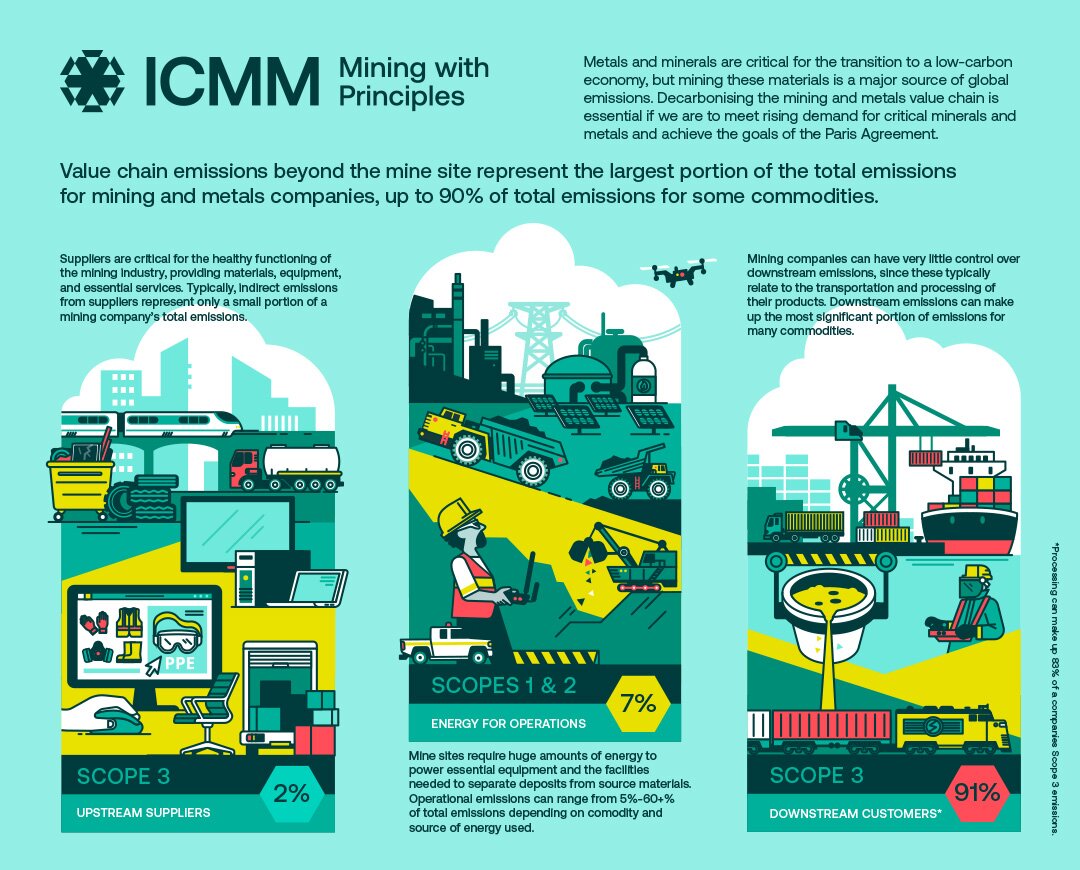
Managing Scope 3 emissions in mining and metals value chains is complex, requiring collaboration between suppliers, operations, and customers.
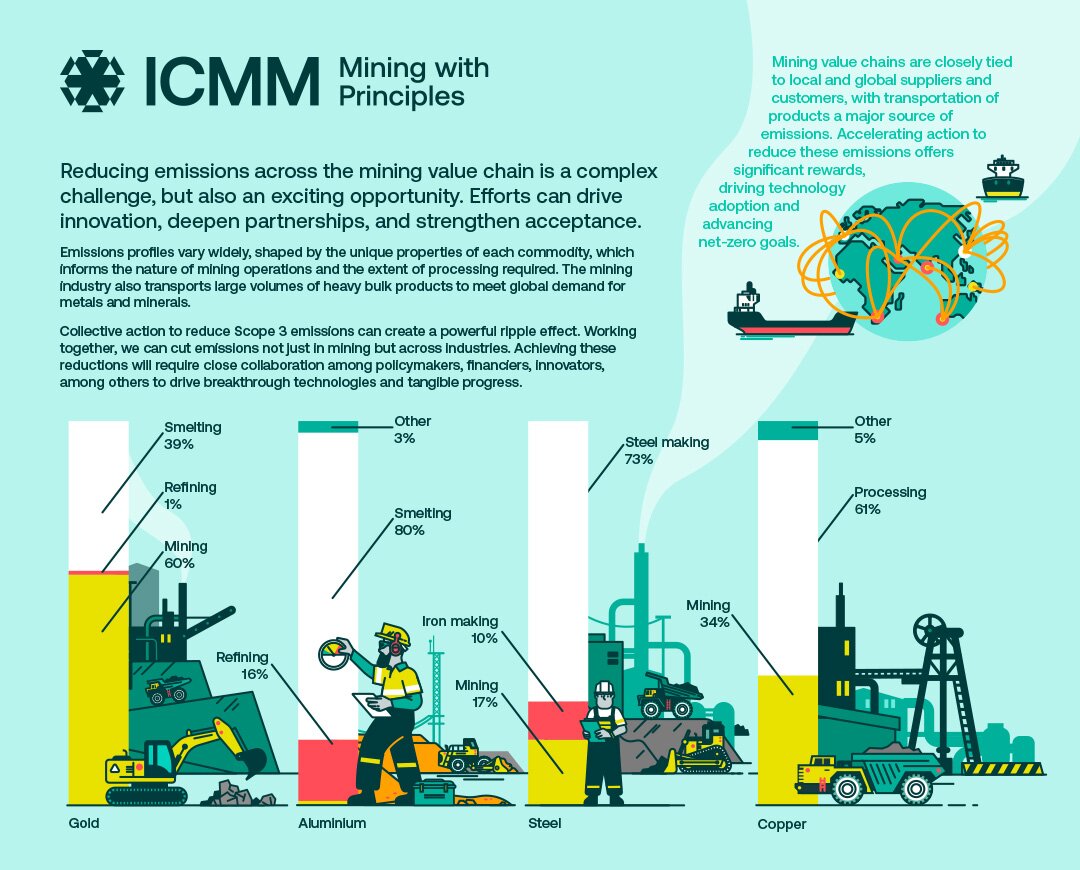
These emissions average 75% of a company’s total, rising to 95% in mining and metals due to the high energy-intensity of processing metals. Decarbonisation is particularly challenging as metals and minerals are the base of products in almost every industry, with emissions varying across commodities and regions.
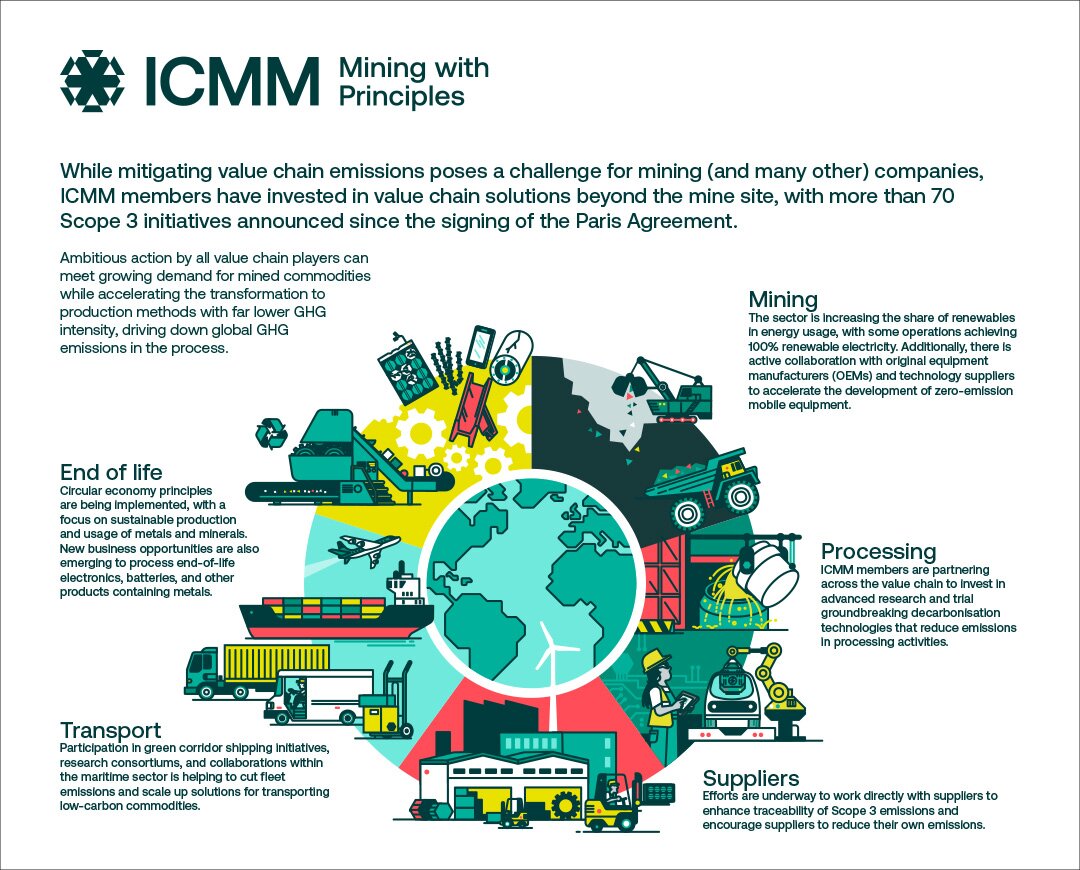
Barriers to reducing these emissions are technical, financial, and political, while transportation and indirect sources add further complexity. However, ambitious action, improved reporting, and better data can accelerate progress. Since the Paris Agreement, ICMM members have invested in over 70 value chain initiatives to drive down emissions across mining, processing, and transport – enhancing traceability of emissions and embedding circular principles to end of life treatment of electronics, batteries, and other products – demonstrating a strong commitment to change.
Our priorities
As stewards of the minerals and metals that are critical to decarbonisation and sustainable development, our industry has a responsibility to lead from the front, strengthening collaboration to reduce emissions, support local communities, and further improve how we produce the materials needed for a sustainable, fossil-free future.
-
Build a collaboration network, to support progress on climate change mitigation and adaptation
Assess and better understand the gaps in our knowledge and management of climate change risk and adaptation and develop tools to support the industry to address those gaps.
- We have engaged with the World Business Council on Sustainable Development and delivered knowledge sharing sessions on the topic. We continue to engage with other leading organisations on the development of new approaches and tools to identify and implement effective responses to climate related risk and adaptation.
-
Identify critical enablers to successfully decarbonise mining operations
Engage key stakeholders and develop practical tools to unlock effective implementation of zero emission vehicles at mine sites and broader decarbonisation goals of the mining industry.
- We are continuing to build our relationships with leading organisations to clearly define and highlight the policy, regulatory, technological, financial, and other support needed to enable the industry to further decarbonise mining operations.
-
Accelerate the transition to greenhouse gas emission-free vehicles
Enable mining operations to adopt GHG emission-free surface mining vehicles by 2040 by increasing the operational readiness of mine sites to be able to adopt zero-emission solutions at a faster pace through the Innovation for Cleaner, Safer Vehicles initiative.
- There are around 28,000 large mine hauling trucks in operation globally. These collectively emit over 69 million tonnes of CO2 (Scope 1, and an additional 15Mt CO2 for Scope 3), based on the consumption of 25 billion litres of diesel fuel. Electric and hydrogen fuelled trucks offer alternatives to more traditional diesel-powered transportation, and ICMM is working alongside OEMs, technology solution providers, and other experts to promote operational and technological innovation.
- We have made significant progress toward our collective goal, and now estimate zero emission vehicles will be available at scale by 2030, a full 10 years ahead of the best estimates when we started this programme in 2018. We will continue to support sharing knowledge and addressing common challenges for adopting zero-emission solutions, with a focus on safety and other enabling conditions to deliver the next generation of emission-free vehicles as a critical part of our collective commitment to achieve 2050 Net Zero goals.
Key resources
Associated member commitments


Principle 06: Environmental Performance
Pursue continual improvement in environmental performance issues, such as water stewardship, energy use and climate change.

Principle 07: Conservation of Biodiversity
Contribute to the conservation of biodiversity and integrated approaches to land-use planning.
Principle 08: Responsible Production
Facilitate and support the knowledge-base and systems for responsible design, use, re-use, recycling and disposal of products containing metals and minerals.

Principle 09: Social Performance
Pursue continual improvement in social performance and contribute to the social, economic and institutional development of host countries and communities.
Principle 10: Stakeholder Engagement
Proactively engage key stakeholders on sustainable development challenges and opportunities in an open and transparent manner, effectively report and independently verify progress and performance.

Position Statement: Climate Change
Responding to the need for an urgent global response to the threat of climate change, across all areas of society and the economy.
Latest updates


Supporting the SDGs
With our strong focus on sustainable development there is great potential for ICMM to support the mining and metals industry in making an important and lasting contribution towards the UN’s global goals. We work with members and partners to catalyse lasting social and economic progress that supports an end to poverty, protects the planet, and ensures prosperity for all.
-
SDG 7: Affordable and clean energy
Mining is energy-intensive, accounting for about 2% of global energy use. The industry is also pivotal in producing energy resources, including uranium for low-carbon energy and minerals like lithium essential for renewable technologies. Companies can reduce their carbon footprint by adopting energy-efficient practices and renewable technologies. Shared-use energy infrastructure in remote areas can provide access to clean energy for local communities.
-
SDG 9: Industry, innovation and infrastructure
Mining requires substantial infrastructure investments, particularly in remote areas. Shared-use infrastructure can provide broader societal benefits, especially in countries with significant infrastructure gaps. This creates opportunities for mining to support national development goals.
-
SDG 12: Responsible consumption and production
Mining generates essential materials for modern life but also produces significant waste. Increasing recycling rates and transitioning to a circular economy for metals requires collaboration across the value chain. By reclassifying waste as a resource (e.g. using sulphuric acid from emissions controls in other industries), mining can drive innovation and job creation.
-
SDG 13: Climate action
Mining can address climate change by reducing emissions and integrating adaptation measures into strategies and policies. As coal-fired power generation remains a significant carbon emitter, advancements in technologies like zero emission large vehicles and carbon capture and storage are critical. Mining operations must also enhance community resilience to the physical impacts of extreme weather.
-
SDG 17: Partnerships for the goals
Mining companies bring significant expertise to partnerships that address sustainable development challenges. Sharing these experiences can inspire further collaboration and demonstrate the potential for collective progress toward achieving the SDGs.


